Loading the content... Loading depends on your connection speed!

Opzioni di ricerca
Cerca
Showing 1–10 of 129 results
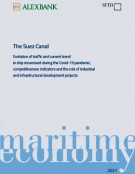
This is the third Report produced by Alexbank and SRM to monitor the dynamics of the Suez Canal, one of the most important maritime and logistical nodes in the world.
SRM and Alexbank intended to analyse, in particular, the impact that the severe Covid-19 pandemic has had and is having on maritime and global trades as well as the way these have affected the dynamics of the Canal. It is clear that Suez has shown remarkable resilience to the effects of the pandemic, exceeding 1 billion tonnes of cargo in 2020 and with 18,829 ships transited. Even in difficult economic times, it has remained a strategic hub for traffic in the Mediterranean, still accounting for 12% of world traffic (7-8% of oil traffic).
The Canal is important for the Egyptian economy and it is equally important for Italian ports, especially Genoa, La Spezia, Trieste and Gioia Tauro, as a key point along the main sea route for trade between Italy and Asia.
In March 2021, the case of the Ever Given, a megaship of over 20,000 TEUs which ran aground in the Suez Canal blocking passage for several days, clearly demonstrated that the dynamics of international maritime trade are highly dependent on this strategic crossroads.
 Details
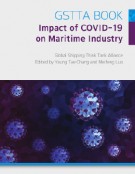
This is the first report released by the “Global Shipping Think Tank Alliance”, of which SRM is part.
The book mainly focuses on the impact of Covid-19 on the shipping industry and the development of the regional shipping industry, highlights practices, policies and challenges in the digital era, and provides suggestions for global port and shipping industry.
This is a collection of 7 presentation-based chapters and one new chapter. Its contributors are GSTTA members from Shanghai International Shipping Institute (China), Korea Maritime Institute (Korea), and World Maritime University (Sweden), Institute of Shipping Economics and Logistics (Germany), Maritime Economy Observatory (Italy), Amsterdam University of Applied Sciences (Netherlands), PolyU Maritime Library and R&D Center (Hong Kong, China). They wrote on the COVID-19’s impact in their respective fields and on how their institutes and/or their governments and industries have responded to the impact.
In particular, the article written by SRM is focused on: COVID-19 Results of a Brief Investigation: the Logistics and Maritime Italian Operators’ Sentiment.
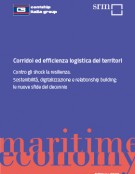
The report aims to offer an updated snapshot of the logistical opportunities and best practices available for import and export through the logistics corridors of Northern Italy, as well as some significant ideas, capable of guiding strategic choices towards the objectives and the priorities expressed by the market and by the main stakeholders in the logistics sector. The study is based on a sample of 400 manufacturing companies, located in Lombardy, Veneto, and Emilia Romagna, analyzing the logistical preferences related to the use of Italian gateway ports and the methods used to transfer goods to and from the ports, with a focus final on the ceramic district of Modena and Reggio Emilia.
The report focuses also on digitalization, sustainability and the Covid-19 impact.
Support our research project, register yourself and purchase the report
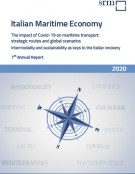
This year’s Report devotes much of its analyses to the impacts of the Covid-19 pandemic on ports and maritime logistics. The phenomenon, in fact, has had considerable negative effects on all the indicators that measure the state of health of the sea economy and the economy in general. In this volume, SRM has carried out a detailed analysis of the various aspects with which the phenomenon is manifesting itself and has also tried, with reasoned estimates, to gauge the impact of the Coronavirus on our logistic system at a national level. In the first part of the volume, important events such as blank sailing, the reduction of the Suez Canal passages and the new configuration of world traffic have been monitored whilst providing an overview of the most recent trends of international trade maritime flows. In addition, a specific analysis is dedicated to providing a strategic vision on what could give our infrastructure more resilience to economic and health shocks in terms of drivers and port models for the future such as intermodality and sustainability, on which the second part of the research is focused. The third part, on the other hand, offers a focus of perspective, dedicated to a topic of great interest that is gradually rising to the forefront given the phenomenon of climate change: the Arctic sea route. This analysis has been carried out by SRM and Intesa Sanpaolo, with the collaboration of prestigious international study centers such as the University of Antwerp and the Shanghai International Shipping Institute.
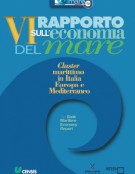
Federazione del Mare, Censis, Cogea, SRM, 2019
This Sixth Edition of the Maritime Economy Report highlights the socio-economic value of the sector and confirms the development and successes achieved, also indicating the challenges to be faced both in Europe and in the Mediterranean, in this delicate historical phase.
The economy of the sea is a sector which, due to its importance, would require more effective and coherent attention on a political and administrative level. It is necessary to draw up a national policy for the sector and to promote it within Europe.
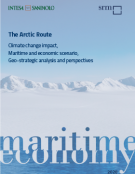
This report has been carried out by SRM and Intesa Sanpaolo. It provides insightful outcomes through a multidisciplinary approach combining different sources of information and considering the possible implications of the Covid-19 pandemic: the great potential as a maritime energy corridor in the short-term, and as a cargo transoceanic route in the long-term; environmental issues for shipping and energy extraction; the challenges posed by the complex legal framework; a geopolitical context in balance between competition and cooperation.
The paper is only available in the English version.
This working paper initiates a series of reports aimed at monitoring one of the most important sectors in Italy and it opens with an international outlook over the most significant effects that the coronavirus has caused on shipping and port logistics. Then, a series of estimates is proposed on the significant impact of the phenomenon on Italian maritime trade (import-export). The report concludes with the results of a Survey on the effects of COVID-19 carried out by SRM through some questions addressed to a sectoral panel made up of the main national players from associations and ports. It is a survey with interesting implications that addresses current problems and needs alongside possible solutions to a future recovery.
The report is available in the English and Italian versions.
The role of sustainability and district tradition in enhancing the value of Italian manufacturing
The path taken in 2019 by SRM and Contship with the redation of the first study on the perception of the efficiency of logistics corridors, by the manufacturing companies of Lombardy, Emilia Romagna and Veneto, continues.
The main objective of the report remains to provide a clear picture of the performance of logistics systems, as perceived by Italian manufacturing companies trading imports and exports. The ambition is to provide companies, associations, public institutions and logistic operators with data and ideas which might influence their choices, investments and development strategies.
Through this investigation, we try to answer complex and articulated questions, concerning the logistic corridors used by the companies that use containers to transport their goods, analyzing the preferred modes of transport used to reach the port infrastructures from the company headquarters and vice versa, and identifying the Italian ports which these companies prefer to use to receive imports and ship exports.
The new edition integrates the suggestions collected through a series of technical focus groups, composed by shippers and cargo owners. Among the novelties of the latest edition, readers will find a focus on the reasons that determine the logistical choices of companies, a drill down on sustainability and a new section, dedicated to one of the best performing production clusters, in terms of export, the wine district of Conegliano – Valdobbiadene.
Video Webinar (Italian version)
PPT Presention (Italian version)
Tags: cargo, Contship Italia Group, logistic, logistics corridors.
Support our research project, register yourself and purchase the report
Much has already been said and written on the Belt and Road Initiative, especially following the Chinese president’s visit in Italy in March 2019, which provided the opportunity to sign a Memorandum of Understanding including several collateral agreements ranging from infrastructure and transport to exchange of data and know-how and included trade agreements and partnership projects in the fields of research and industry.
Before discussing the core of this paper, it seems necessary to briefly outline the reasons that led to the initial design, development and expansion of the BRI, which is already encompassing more than 100 countries and seems bound to involve many more.
This paper is extracted from the SRM’s 6th “Italian Maritime Economy” Report .
Tags: Belt and Road, Pino Musolino, Port Network Authority of the North Adriatic Sea, Porti.
Support our research project, register yourself and purchase the report
China has gradually become a big energy and resource user in the global scale into the 20th century. China’s iron ore and coal imports are taking rapidly rising shares in global seaborne trade, with “China factors” getting predominant for determining the global dry bulk market. In recent years, the shipping industry has been suffering, and China’s dry bulk shipping market is also changing quietly. This article analyzes the changes of China factors and the resulting impact on the global shipping market from perspectives of industrial chain structures of various cargoes.
The research is available only in the English version.
This paper is extracted from the SRM’s 6th “Italian Maritime Economy” Report .
Tags: China, Fei Shao, Shanghai International Shipping Institute, shipping, sisi.
SHAREHOLDERS

MARITIME PARTNERS

SRM IS PART OF







© copyright 2025 S.R.M. Studi e Ricerche per il Mezzogiorno - P.iva 04514401217 - PEC: amministrazione@pec-srm.it - UNI EN ISO 9001 Certification
Via Toledo, 177 - 80134 Naples, Italy - Tel. +39 081 7913758-61 - Fax +39 0817913817


