Loading the content... Loading depends on your connection speed!

Opzioni di ricerca
Cerca
Showing 41–50 of 129 results
The phenomenon of Special Economic Zones (SEZ) has been steadily increasing and saw no deceleration neither during globalization nor the global economic crisis of the last years. The report describes the conditions created by the the decree-law 91/2017 regarding “Urgent provisions for the economic growth of the Mezzogiorno” (in G.U. 20th June 2017), converted into Law on the 3rd of August 2017, no. 123 (in G.U. 12th August 2017), that provided, among other things, in Chapter II articles 4-5, the possibility of establishing the so-called SEZ, Special Economic Zones. The paper includes also an analysis on SEZ in Tanger Med port in Morocco, Suez Canal in Egypt and in the port of Trieste in Italy.
 Details
Support our research project, register yourself and purchase the report
In this paper SRM analyses the role of the Asian Infrastructure Investment Bank (AIIB). This is a multilateral financial institution led by China and created for promoting economic integration and interdependence in the Asian region as well as for liaising closely with other multilateral development banks such as the World Bank and the Asian Development Bank. The main objective of the bank is to finance the development of infrastructure in Asia and nearby regions. At first, in fact, it was designed as an instrument mainly aimed at supporting the projects of the One Belt One Road Initiative (OBOR) however, its mission was then expanded. The essay provides a detailed analysis of this process.
The research (English and Italian version) may be purchased from this website in digital version.
Tag: AIIB.
Support our research project, register yourself and purchase the report
The New Silk Road is strongly related to China’s ‘One Belt, One Road’ initiative. This is a broad initiative including rail and maritime connections between China and Europe and a related investment portfolio in logistics infrastructure, such as investment in seaports and in warehousing. In this paper we present the New Silk Road and compare this initiative with the container landbridge initiatives of the 1980s. We indicate how the New Silk Road can be compared to alternative routes like deep-sea, air-cargo and innovative solutions like unmanned cargo aircrafts. In addition we relate the New Silk Road with scenario’s related to re-export and broader investment schemes. Also the impact on port volumes will be discussed. The paper concludes with the impact on possible structural disruptions in the North-West European port system.
This paper is available only in the English version.
Tags: Bart Kuipers, Erasmus University Rotterdam, Onno de Jong.
Support our research project, register yourself and purchase the report
This paper, provided by Shanghai International Shipping Institute, represents the point of view of China on the One Belt One Road Initiative (OBOR) with special attention to its maritime part known as Maritime Silk Road. For instance, in 2016 investment in the huge ports of this country amounted to approximately $18.6 billion.
The paper is available only in the English version.
Tags: Liu Weirong, Shanghai International Shipping Institute, Zhao Nan.
Support our research project, register yourself and purchase the report
This paper, edited by the University of Hamburg, deals with an innovative topic, “sustainable ports”. In this contribution it is argued that development strategies for a sustainable future of ports need to be exclusively elaborated by thoroughly evaluating the economic activities carried out in ports, their potential on the market and external costs linked to them. Ports need to adjust their strategy within a sustainable framework and distribute their resources with the aim of maximising the generation of value in the long term. It is also important to find smart ways of reducing the impact on the environment, especially if the port is nestled in a city. This is the only way for port communities and urban centres to coexist and develop simultaneously.
The paper is available only in the English version.
Tags: Hamburg, Kühne Logistics University, Michele Acciaro.
Support our research project, register yourself and purchase the report
This paper is important to gain an understanding of the general context in which we are operating. Globalisation has surely benefited many countries since in the years of its success there was an increase in the average income. Globalisation also contributed to the reduction of general poverty. Forecasts show that despite protectionism, globalisation will not stop and in fact it has now moved to an advanced stage where emerging economies such as China generate new flows of FDIs and new economies (i.e. African countries) attract capital from all over the world.
The research (English and Italian version) may be purchased from this website in digital version.
Tag: Giuseppe Russo.

Mare Straetmans is currently the managing director of PortXL, the World Port Accelerator. The Port of Rotterdam is the innovation hub for port business around the world. PortXL is aiming to develop an ecosystem for port startups worldwide. PortXL focusses on scouting the best startups, and bring them to Rotterdam for three months, to find their first clients. This way building the port business of the future.

Windward is a maritime data and analytics company that offers specialized data and services to government agencies and private corporations. We collect and analyze over 200 million data points per day. We convert this massive amount of data into information that our clients can act on, in real time. The Windward team, 75 and growing, is comprised of data scientists and shipping experts who work together to shed light on what’s really happening at sea.
Global economic growth remained largely fl at at about 3.1% in 2016, while world seaborne trade growth finally rebounded from 1.9% in 2015 to 2.4% in 2016. The market is still struggling to absorb the new tonnage coming in, even if there are signs of a reduction in fleet growth (about 3.2% in 2016 against 3.4% in 2015). Growth in dry bulk trade has been decelerating and reached just 1.4% in 2016, the slowest pace since 2010. After several years of volatility, oil trade growth stabilized around 3.6% in 2016. Container throughput growth reachs 1.5% in 2016. With only 34.1m dwt in newbuilding orders during 2016, the year was very much on par with 2009’s record low after the world was hit by the worst economic crisis since 1929. To read more click oh “details”.
Support our research project, register yourself and purchase the report
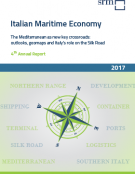
The 2017 Report on the Maritime Economy has now reached its fourth issue and is based on two mainstays. Firstly, there is an analysis of the principal economic data of the sector on a national and global scale, with updates on the features of ports and shipping in the global, European and Italian scene as well as in-depth analyses of routes and dynamics of traffic. Secondly, this volume deals with the evolution of Chinese investment in ports and maritime terminals in the Mediterranean and in Northern Europe, a topic SRM has been following regularly over the last few years. This phenomenon has already had an influence on the Mare Nostrum and will probably continue for a long time, as evidenced by the huge plan of infrastructural investment that the Dragon is implementing in order to complete the One Belt One Road Initiative. This project provides for the creation of seaborne and land routes which will allow China to expand its trade relationship with Europe and Asia through the implementation and improvement of transport infrastructure. Analyses are supported by fascinating and thought-provoking case studies.
The Fourth Annual Report (English and Italian version) may be purchased from this website in digital version, at a discounted price. To request the version on paper (30 euros + shipping costs) write to comunicazione@sr-m.it
SHAREHOLDERS

MARITIME PARTNERS

SRM IS PART OF







© copyright 2025 S.R.M. Studi e Ricerche per il Mezzogiorno - P.iva 04514401217 - PEC: amministrazione@pec-srm.it - UNI EN ISO 9001 Certification
Via Toledo, 177 - 80134 Naples, Italy - Tel. +39 081 7913758-61 - Fax +39 0817913817


